Wednesday, 27 February 2013
Conspiracy Theory
We were right to be afraid of that awkward aluminum space-barbecue if its presence has led to the exclusion of students in practical and progressive math classes from the pursuit of an arts degree.
Is this what the Russians intended all along?!
Wednesday, 13 February 2013
Who Created Canadian History, Jack Granatstein?
From "The new Canadian Museum of History: Whose history will it tell?"
Kate Taylor - The Globe and Mail - Dec 16, 2012
"In an era when museums are increasingly called on to tell complex stories rather than simply display artifacts, the rebranding (of the Canadian Museum of Civilization) announced by the federal government in October is becoming a tussle of its own. Competing visions for the renovation of the history exhibits at Canada's most visited museum pit conservatives who favour political history of the kings-and-battles variety against liberals who prefer the museum's past emphasis on social and multicultural history, but want a lot more of it."
best thing, though, in that museum was that everything always stayed right where it was. Nobody'd move. You could go there a hundred thousand times, and that Eskimo would still be just finished catching those two fish . . . and that squaw with the naked bosom would still be weaving that same blanket. Nobody'd be different. The only thing that would be different would be you. Not that you'd be so much older or anything. It wouldn't be that, exactly. You'd just be different, that's all. You'd have an overcoat on this time. Or the kid that was your partner in line the last time had got scarlet fever and you'd have a new partner. Or you'd have a substitute taking the class, instead of Miss Aigletinger. Or you'd heard your mother and father having a terrific fight in the bathroom. Or you'd just passed by one of those puddles in the street with gasoline rainbows in them. I mean you'd be different in some way--I can't explain what I mean. And even if I could, I'm not sure I'd feel like it."
-Holden Caulfield (The Catcher in the Rye)
Contrary to Holden, who may represent the typical student's view of history, the Harper government's prioritization of history suggests that our stories may change as quickly as we do. All the more reason to pay close attention to who's talking and who's listening when something's being said.
Friday, 8 February 2013
The Epistemologistas
"Philosophers, when they have addressed the issue at all, have tended to group philosophy with science as the most gender-neutral of all disciplines. But feminist critiques reveal that this alleged neutrality masks a bias in favor of institutionalizing stereotypical masculine values into the fabric of the discipline–its methods, norms, and contents. In so doing, it suppresses values, styles, problems, and concerns stereotypically associated with femininity. Thus, whether by chance or by design, it creates a hegemonic philosophical practice in which the sex of the knower is, indeed epistemologically significant."
-Lorraine Code
Emanuella Kant
Davitte Hume
Juanita Locke
Renée Descartes
"Supposing truth is a woman–what then? Are there not grounds for the suspicion that all philosophers, insofar as they were dogmatists, have been very inexpert about women? That the gruesome seriousness, the clumsy obtrusiveness with which they have usually approached truth so far have been awkward and very improper methods for winning a woman's heart?"
-Friedrich Nietzsche
Thursday, 31 January 2013
A Few Solutions for Encouraging Language Diversity
I find that those authors who adress the topic of Aboriginal education are typically better at pointing out problems than solutions. I don't mean to say that a focus on problems makes their work less valuable. However, as a future teacher I am concerned to find ways of teaching which will enable the success of all students in my classroom.
Specifically with respect to encouraging language diversity, Sharla Peltier does echo a broad recommendation for teachers: "Laurence and Fey recommend a pragmatic approach for children with gramatical errors which emphasizes language in context. These clinicians recommend associating relevant social contexts in which to use particular gramatical forms."
So what would it look like to follow this guideline? I had a few ideas:
1. I think it begins with being explicit about what we are teaching (this is beginning to be a recurring theme for me). The starting point is to be open about explaining that Standard English is a dialect to be used in certain situations for the sake of clarity and formality. If students recognize that their English dialect is not defective, they will not see the use of Standard English as an attack on their traditional way of speaking.
2. When giving assignments It will be helpful to stipulate which form of English will be expected according to what would be required in an authentic setting. When assigning formal letters and resumés, a teacher can emphasize that Standard English grammar will be required, and the writing will be graded accordingly. On the other hand, less formal writing assignments, including blogs, memoirs, and micro-fiction, can be used to affirm other dialects. Explicit mention of whether or not formal English will be essential so as not to confuse students about when they are learning Standard English grammar, and when they are not.
3. Students can be encouraged to write in alternative dialects with assignments that require them to dip into their own, unique linguistic expertise. For example, in an everyday writing assignment students could be asked to use words that they use in everyday speech, but which they would not normally use in the work they hand in. Students could even be encouraged to choose words from other languages, assuming that they are used effectively in context. The purpose of this assignment would be to create a level of comfort and familiarity with writing that has been broken down by the requirement to write in Standard English. If the use of unfamiliar language creates confusion for the teacher, an opportunity will have become available to draw upon student expertise, inverting the typical instructional pattern in the classroom whereby the teacher would typically instruct the student in an unfamiliar dialogue, instead of the other way around.
4. If it is possible for written work to be studied in alternative dialects, the teacher can continue to draw on students for expertise as readers and interpreters of the work. Canadian fiction and non-fiction is available in Aboriginal and Metis dialects which should bear some resemblance to those spoken by students.
I'm hopeful that these ideas will be of use for creating a positive learning environment for all students. Let's turn the classroom experience from this . . .
Specifically with respect to encouraging language diversity, Sharla Peltier does echo a broad recommendation for teachers: "Laurence and Fey recommend a pragmatic approach for children with gramatical errors which emphasizes language in context. These clinicians recommend associating relevant social contexts in which to use particular gramatical forms."
So what would it look like to follow this guideline? I had a few ideas:
1. I think it begins with being explicit about what we are teaching (this is beginning to be a recurring theme for me). The starting point is to be open about explaining that Standard English is a dialect to be used in certain situations for the sake of clarity and formality. If students recognize that their English dialect is not defective, they will not see the use of Standard English as an attack on their traditional way of speaking.
2. When giving assignments It will be helpful to stipulate which form of English will be expected according to what would be required in an authentic setting. When assigning formal letters and resumés, a teacher can emphasize that Standard English grammar will be required, and the writing will be graded accordingly. On the other hand, less formal writing assignments, including blogs, memoirs, and micro-fiction, can be used to affirm other dialects. Explicit mention of whether or not formal English will be essential so as not to confuse students about when they are learning Standard English grammar, and when they are not.
3. Students can be encouraged to write in alternative dialects with assignments that require them to dip into their own, unique linguistic expertise. For example, in an everyday writing assignment students could be asked to use words that they use in everyday speech, but which they would not normally use in the work they hand in. Students could even be encouraged to choose words from other languages, assuming that they are used effectively in context. The purpose of this assignment would be to create a level of comfort and familiarity with writing that has been broken down by the requirement to write in Standard English. If the use of unfamiliar language creates confusion for the teacher, an opportunity will have become available to draw upon student expertise, inverting the typical instructional pattern in the classroom whereby the teacher would typically instruct the student in an unfamiliar dialogue, instead of the other way around.
4. If it is possible for written work to be studied in alternative dialects, the teacher can continue to draw on students for expertise as readers and interpreters of the work. Canadian fiction and non-fiction is available in Aboriginal and Metis dialects which should bear some resemblance to those spoken by students.
I'm hopeful that these ideas will be of use for creating a positive learning environment for all students. Let's turn the classroom experience from this . . .
Into something more like this . . .
. . . well, sort of, anyway.
Friday, 25 January 2013
Linguistic Gymnastics: A How To
The stalwart defence of Standard English (as defined here) as the only suitable dialect for instruction requires a considerable amount of creativity at times. It seems that, once the clear relationship between power and "correct" language has been exposed, the defence of such a dialect would be better left to acrobats than to philosophers. Of course, it goes without saying that Standard English has arrived at a particular level of precision that is beneficial for speaking clearly, but to argue that the grammar of Standard English should be the exclusive dialect for classroom use is to limit oneself for the sake of artifice alone. Such artificial limitation might be appropriate if teaching were a circus act, but I don't look good in a leotard.
However, if you do decide to limit the classroom experience to one particular dialect, there is a good company of predecessors for you who have laid out a fairly tidy methodology:
Step 1: Convince everybody that there was a time and place where everyone spoke perfectly. Make sure that no one from that time is still alive and that the language is no longer spoken, or some incongruences are bound to pop up. (Most scholars recommend Rome under Augustus Caesar)
Step 2: Convince your students that they and their families are all degenerates speaking an almost incomprehensibly mumbled derivative of Language X and that they have almost no hope of getting a good job unless they learn it right. (For tips, study the administration of the British East India company).
Step 3: Teach your students to speak and read only the language of that time and place. If students begin to notice variations in writers from that period, then narrow in on one particularly eloquent speaker of that language and include every other writer among the list of degenerates. (The individual chosen must be a white male; the Roman senator Cicero has been, historically speaking, the fellow to go with).
Step 4: If you encounter new objects that have not been described in the writings of Person X, use words from his vocabulary to come up with long-winded descriptors. (Examples of good Ciceronian Latin from the Lexicon Recentis Latinitatis published by the Vatican include: for "hot dog," pastellum botello fartum; instead of "motorcycle," borrota automataria levis; when going to the "disco" say orbium phonographicorum theca.)
Follow these four easy steps, and you'll be well on your way toward establishing the perfect classroom.
| Bust of Cicero |
“What effrontery then would he have who should insist that we speak, on all occasions as Cicero did? Let him bring back to us first that Rome that was; let him give us the Senate... let him give back the college of augurs and soothsayers, the chief priests... praetors, tribunes of the people, consuls, dictators, Caesars... shrines, sanctuaries, feasts of the gods, sacred rites... Then, since on every hand the entire scene of things is changed, who can today speak fittingly unless he is unlike Cicero?
-Erasmus
"It is a subtlety that God learned Greek when he wanted to become a writer, and also that he did not learn it well."
-Friedrich Nietzsche
Friday, 18 January 2013
The Creative Power of Language for Social Change
"The political imperative here is to reclaim understandings of space, time, language, and context from their frozen state within much of social and linguistic theory. The background of the everyday use of language has to be opened up for re-examination, turned from background into foreground, and thereby invested with new politics"
-Alastair Pennycook, Language as a Local Practice
I haven't read much Foucault, but it's tough (especially in a university) not to be steeped with his ideas. Here's what I've picked up along the way: Foucault, in step with neo-marxism, makes truth a commodity, the means for the production of which is in the possession of the powerful. "Discourse" is the system within which the daily patterns of human language are situated with relation to that truth. Language is always subject to a particular discourse that determines what people talk about, how they choose to express themselves, and even who they understand themselves to be. Foucault exposes the power driven discourses which give meaning to language, and in so doing re-situates the means for producing truth and consolidating power. His is a social theory which not only describes our world, but also seeks to change it by identifying those in control.
I have to admit that this theory has always left me feeling constrained, as I suppose it should. Call me individualistic or idealistic (or both), but the idea that what I do is controlled by social forces never seemed to fit with my experience. At the same time, I could never seem to deny it very intelligently.
Enter Alastair Pennycook, whose alternative understanding of language as a local practice is also infused with social theory and the potential for reflexive change. He argues, as can be deduced from the quote above, that the repeated actions of everyday life, or practices, are what drive the creation and meaning of language. Since language is itself one of these practices, it turns upon itself as an active, creative agent for change. Since socio-linguistic change is based on localized activity, power is not only found at the macro level, but the potential for self-determination also exists at the grassroots, even, potentially, at the individual level. Pennycook does not deny the existence of social control, but he maintains the potential for voluntary action and local change without undermining the reality of that control.
With all this mumbo-jumbo I'm reminded another thoughtful fellow's take on social-determinism and the possibility of free action. William Shakespeare wrote about it quite often, reflecting especially on the artist's role in resisting a pre-determined fate. Shakespeare mused that when we make art, as we always do when we engage in language, we are forming an alternative social reality, contrary to the one prescribed by fate. I think this alternative reality, where the world's power structures can be turned upside down, is what he is hinting at, for example, when Romeo and Juliet meet at the balcony under the cover of darkness. Through language, the young couple is able to create a world where there are no Montagues and Capulets, none of the patriarchy which predetermines the tragedy of the sunlit world. In the darkness, their words have the power to build something new and beautiful. While we all know the disaster which ensues, what is not as often recognized is the triumph of their world over the old social reality when, at the end of the play the lovers dig in their heels and cheat the fate which would drive them apart. Instead of perishing, they are immortalized when golden statues are erected in their memory, an artistic expression which forms a symbolic fixture in the new social order they have affected. Fate and freedom, death and immortality, as the grassroots power of activity meets with the power of social control, Shakespeare is able to affirm the existence of both without compromise.
When we engage in language as an artistic endeavor, we are not simply acting according to a prior framework, but on the basis of a local practice. Social forces are undoubtedly at play, and though they may constrict us to the point of making our role as actors all but forgotten, these forces do not eliminate the potential and ongoing reality of social change which is active at every level of society.
I think I like this Mr. Pennycook.
| Giulietta - Nereo Constantini |
"...love-devouring death do what he dare--
It is enough I may call her mine."
Romeo, Romeo and Juliet, II.v.7-8
Friday, 11 January 2013
How Do You Like Your Beef?
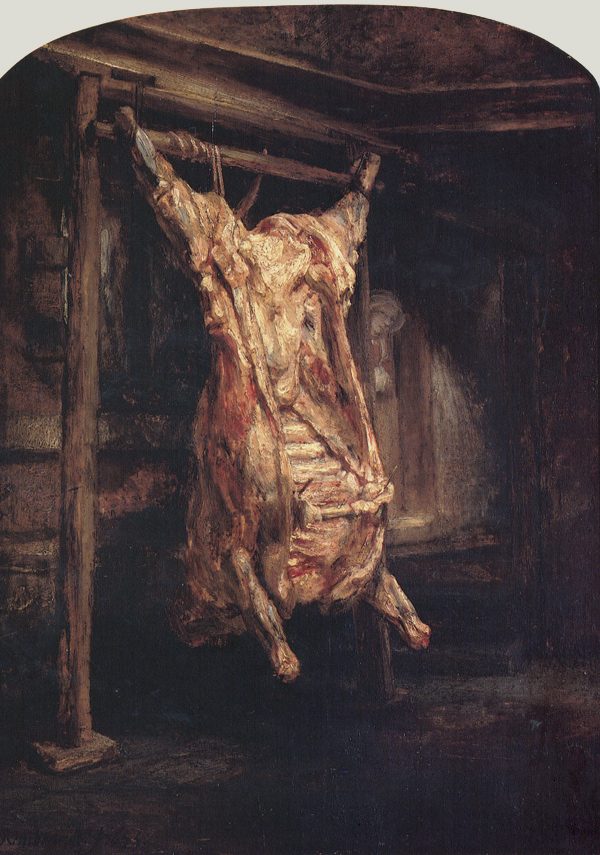
Though I was not sufficiently entertained to watch through to the end of Mona Lisa Smile, starring Julia Roberts, it did have its moments. In the movie, modern art (including Chaim Soutine's sexy side of beef below) serves as a metaphorical parallel to a young teacher's struggle against top-down authority in an ultra-conservative, all-girls school. Thankfully, she stayed true to herself and didn't let anyone tell her what to think . . . or at least I hope so; I didn't see the end!
Along the way she asked a pretty good question: "What is art? What makes it good or bad? And who decides?"
I don't know what the right answer is, but certainly we can at least say that no one else should be able to tell us what the answer is, right? I mean, that was the whole point of the movie. Challenge authority! Who are they to tell us what to appreciate? What if Hitler really was the Michelangelo of landscape art?! World War II could have been avoided if only we had noticed in time.
But really, who's to say what's good art and what's bad? Is it all just a measure of control, or is there really something to it? Does some art have value and other art not?
Ok, there are a lot of questions here without much space in which to answer them.
So I won't.
I'll dig deeper because maybe we're starting at the wrong end.
Can we at all fathom what art is without understanding what an artist is? Is the artist a creator? a reflector? an illuminator? a bricoleur? Is the artist accountable to someone? to nature? to God? to art? to us?
The way we answer these questions (and though we may not be able to articulate our answers, we have indeed answered them) will determine what we see when we look at art. It will help us decide which, if any, of the pictures below really is art. Each of these answers is also tied to a philosophy, an epistemology, and a way of looking at the world. Though Julia Roberts' character was able to maintain her intellectual freedom (which in Hollywood = integrity) despite the tyrannical pressures of the thought police, we in the real world are unlikely to be so lucky. If we probe deep enough, I expect that each of us will discover that somewhere along the line we were told an answer to these questions, and we believed it.
That's OK.
At the same time, it might be a good idea to take some time and try to figure out from whom, what, or where those answers came. I'm still working on that part.
I think I like the Rembrandt best, but the Soutine is a close second.
Along the way she asked a pretty good question: "What is art? What makes it good or bad? And who decides?"
I don't know what the right answer is, but certainly we can at least say that no one else should be able to tell us what the answer is, right? I mean, that was the whole point of the movie. Challenge authority! Who are they to tell us what to appreciate? What if Hitler really was the Michelangelo of landscape art?! World War II could have been avoided if only we had noticed in time.
But really, who's to say what's good art and what's bad? Is it all just a measure of control, or is there really something to it? Does some art have value and other art not?
Ok, there are a lot of questions here without much space in which to answer them.
So I won't.
I'll dig deeper because maybe we're starting at the wrong end.
Can we at all fathom what art is without understanding what an artist is? Is the artist a creator? a reflector? an illuminator? a bricoleur? Is the artist accountable to someone? to nature? to God? to art? to us?
The way we answer these questions (and though we may not be able to articulate our answers, we have indeed answered them) will determine what we see when we look at art. It will help us decide which, if any, of the pictures below really is art. Each of these answers is also tied to a philosophy, an epistemology, and a way of looking at the world. Though Julia Roberts' character was able to maintain her intellectual freedom (which in Hollywood = integrity) despite the tyrannical pressures of the thought police, we in the real world are unlikely to be so lucky. If we probe deep enough, I expect that each of us will discover that somewhere along the line we were told an answer to these questions, and we believed it.
That's OK.
At the same time, it might be a good idea to take some time and try to figure out from whom, what, or where those answers came. I'm still working on that part.
I think I like the Rembrandt best, but the Soutine is a close second.
| The Bull, state VII - Pablo Picasso |
| Bull - Adriaen van de Velde |
Subscribe to:
Posts (Atom)