Friday, 18 January 2013

The Creative Power of Language for Social Change

"The political imperative here is to reclaim understandings of space, time, language, and context from their frozen state within much of social and linguistic theory. The background of the everyday use of language has to be opened up for re-examination, turned from background into foreground, and thereby invested with new politics"

-Alastair Pennycook, Language as a Local Practice

I haven't read much Foucault, but it's tough (especially in a university) not to be steeped with his ideas. Here's what I've picked up along the way: Foucault, in step with neo-marxism, makes truth a commodity, the means for the production of which is in the possession of the powerful. "Discourse" is the system within which the daily patterns of human language are situated with relation to that truth. Language is always subject to a particular discourse that determines what people talk about, how they choose to express themselves, and even who they understand themselves to be. Foucault exposes the power driven discourses which give meaning to language, and in so doing re-situates the means for producing truth and consolidating power. His is a social theory which not only describes our world, but also seeks to change it by identifying those in control.

I have to admit that this theory has always left me feeling constrained, as I suppose it should. Call me individualistic or idealistic (or both), but the idea that what I do is controlled by social forces never seemed to fit with my experience. At the same time, I could never seem to deny it very intelligently.

Enter Alastair Pennycook, whose alternative understanding of language as a local practice is also infused with social theory and the potential for reflexive change. He argues, as can be deduced from the quote above, that the repeated actions of everyday life, or practices, are what drive the creation and meaning of language. Since language is itself one of these practices, it turns upon itself as an active, creative agent for change. Since socio-linguistic change is based on localized activity, power is not only found at the macro level, but the potential for self-determination also exists at the grassroots, even, potentially, at the individual level. Pennycook does not deny the existence of social control, but he maintains the potential for voluntary action and local change without undermining the reality of that control.

With all this mumbo-jumbo I'm reminded another thoughtful fellow's take on social-determinism and the possibility of free action. William Shakespeare wrote about it quite often, reflecting especially on the artist's role in resisting a pre-determined fate. Shakespeare mused that when we make art, as we always do when we engage in language, we are forming an alternative social reality, contrary to the one prescribed by fate. I think this alternative reality, where the world's power structures can be turned upside down, is what he is hinting at, for example, when Romeo and Juliet meet at the balcony under the cover of darkness. Through language, the young couple is able to create a world where there are no Montagues and Capulets, none of the patriarchy which predetermines the tragedy of the sunlit world. In the darkness, their words have the power to build something new and beautiful. While we all know the disaster which ensues, what is not as often recognized is the triumph of their world over the old social reality when, at the end of the play the lovers dig in their heels and cheat the fate which would drive them apart. Instead of perishing, they are immortalized when golden statues are erected in their memory, an artistic expression which forms a symbolic fixture in the new social order they have affected. Fate and freedom, death and immortality, as the grassroots power of activity meets with the power of social control, Shakespeare is able to affirm the existence of both without compromise.

When we engage in language as an artistic endeavor, we are not simply acting according to a prior framework, but on the basis of a local practice. Social forces are undoubtedly at play, and though they may constrict us to the point of making our role as actors all but forgotten, these forces do not eliminate the potential and ongoing reality of social change which is active at every level of society.

I think I like this Mr. Pennycook.


 Giulietta - Nereo Constantini
"...love-devouring death do what he dare--
It is enough I may call her mine."

Romeo, Romeo and Juliet, II.v.7-8

Friday, 11 January 2013

How Do You Like Your Beef?

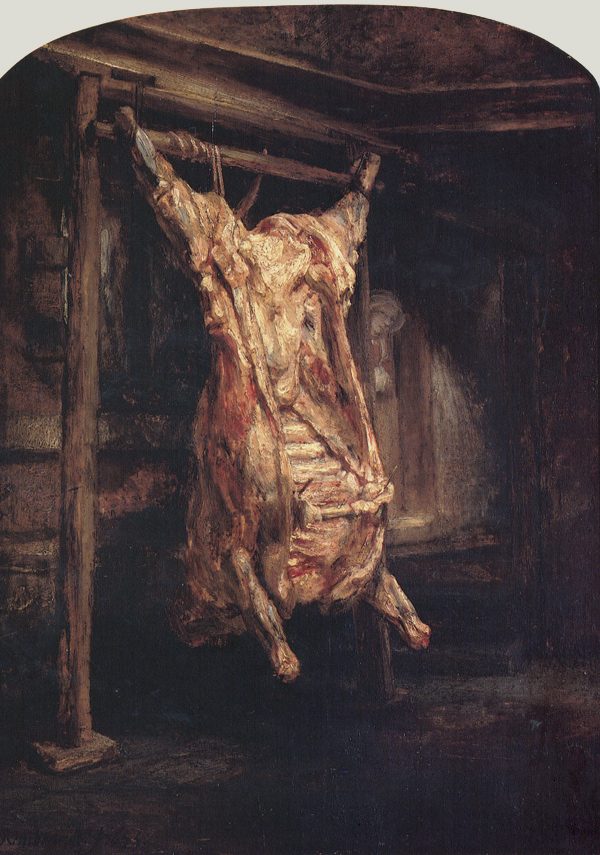
Though I was not sufficiently entertained to watch through to the end of Mona Lisa Smile, starring Julia Roberts, it did have its moments. In the movie, modern art (including Chaim Soutine's sexy side of beef below) serves as a metaphorical parallel to a young teacher's struggle against top-down authority in an ultra-conservative, all-girls school. Thankfully, she stayed true to herself and didn't let anyone tell her what to think . . . or at least I hope so; I didn't see the end!

Along the way she asked a pretty good question: "What is art? What makes it good or bad? And who decides?"

I don't know what the right answer is, but certainly we can at least say that no one else should be able to tell us what the answer is, right? I mean, that was the whole point of the movie. Challenge authority! Who are they to tell us what to appreciate? What if Hitler really was the Michelangelo of landscape art?! World War II could have been avoided if only we had noticed in time.

But really, who's to say what's good art and what's bad? Is it all just a measure of control, or is there really something to it? Does some art have value and other art not?

Ok, there are a lot of questions here without much space in which to answer them.

So I won't.

I'll dig deeper because maybe we're starting at the wrong end.

Can we at all fathom what art is without understanding what an artist is? Is the artist a creator? a reflector? an illuminator? a bricoleur? Is the artist accountable to someone? to nature? to God? to art? to us?

The way we answer these questions (and though we may not be able to articulate our answers, we have indeed answered them) will determine what we see when we look at art. It will help us decide which, if any, of the pictures below really is art. Each of these answers is also tied to a philosophy, an epistemology, and a way of looking at the world. Though Julia Roberts' character was able to maintain her intellectual freedom (which in Hollywood = integrity) despite the tyrannical pressures of the thought police, we in the real world are unlikely to be so lucky. If we probe deep enough, I expect that each of us will discover that somewhere along the line we were told an answer to these questions, and we believed it.

That's OK.

At the same time, it might be a good idea to take some time and try to figure out from whom, what, or where those answers came. I'm still working on that part.

I think I like the Rembrandt best, but the Soutine is a close second.


The Bull, state VII - Pablo Picasso

Bull - Adriaen van de Velde


Carcass of Beef - Rembrandt Harmenszoon van Rijn

Carcass of Beef - Chaim Soutine
Hamburger - Andy Warhol
Big Mac - McDonalds Canada

Monday, 3 December 2012

Tools and Trouble Spots: A Final Reflection

My wife teaches English to refugees, and the other day we had a conversation about what it's like to teach a new language to students who are completely illiterate even in their old language. Some of them don't even know how to hold a pencil. I like to look at their artwork; it's like a child drew it. Makes you smile even more when you know it's drawn by a 40-year-old man.

One of the things she's noticed is that students who do not have experience with reading and writing lack the skills and strategies to tackle Gallagher's "trouble-spots," the places where confusion tends to arise. They have difficulty looking for context clues. They don't think to sound words out. Often when they get stuck, they stay stuck, because they lack the tools to solve their problems.

The trouble is that we very rarely recognize that we're missing out on strategies for doing our work. Rather, it's easier for a student to internalize failure and believe that it's about a lack of ability rather than a lack of knowledge. My wife tells me stories about students who fake knowing, who memorize what others are reading, who get put in the wrong classes because they can cheat the placement exams. She also tells me about students who despair, who say they just can't read, though she knows better. 

I think many of our students will get stuck in the same way––lots of them smart kids who simply lack the tools to become effective readers and thinkers. I think one of the things theory does so well is to bring strategies for reading, for overcoming trouble-spots and arriving at understanding meaning, out into the open. Imagine how daunting it would be to learn construction, for example, if your boss never showed you he was using tools! With the right tools, it's something almost anyone could learn. If students know about the tools we use to arrive at meaning, I think they will be much less likely to feel alienated from the text or to blame their lack of understanding on inability. Learning theory is so different from learning many of the things I learned in English class. There's really no way to fake it. The application of these critical tools is a skill; either you've learned it or you haven't. I think learning theory begins to put the value back into ELA classrooms, which have the potential to become little more than glorified book clubs with lessons in Eurocentrism. The time spent musing on theories and strategies for teaching English this semester has been enlightening and beneficial. I, for one, am thankful for it.

Stefan Luchian - At Nami (wood cutter)


Saturday, 1 December 2012

Not Just Reading the World as It Used To Be

No one would argue against the idea that the internet has changed the way we communicate. Just today, the course of my procrastination took me to two articles about the role of social media in defining America. One article told the story of how the Obama campaign made use of its tumblr to rally its young supporters to go out and vote. The other posted examples of the way a "twitter bot" has become an advocate for both good grammar and the respect of speakers of other languages. Both articles used innovative forms of communication, the first posting links in just about every sentence, and the second combining twitter posts with a traditional news story.

We don't need stories like these to let us know that new, more flashy and lighthearted ways of communicating are changing the way we look at the world. The Obama campaign may not have been won through tumblr and memes, but if the students at my school were voting, it certainly would have been. Students who knew nothing about policies were quite well informed about Mitt Romney's latest blunders. The Obama campaign shows what effective internet communication can look like, leading me to wonder, what would effective internet communication look like in schools?

I have to admit, I was not won over by the iLit series' take on microfiction and twitter novels. Somehow putting memes into a print book and sterilizing them according to copyright law seems to suck the life out of them––kids get that. At the same time, if proponents for ELA are going to make a claim for teaching students to "read the world," as both authors we studied this term do, teachers need to be engaging students in relevant forms of communication. The ability to do so will be one of the benefits teachers reap with the advent of technology in the classroom. This blog itself has allowed us to explore the benefits of alternative forms of communication in context, and I for one have found its informal style liberating and comfortable. Of course, as with anything new, there will be concerns to mirror the benefits, but the fact is that students already are engaged in this form of communication. Like it or not, we're going to have to find a way to catch up.


"Anyone who tries to make a distinction between education and entertainment doesn't know the first thing about either."
-Marshal McLuhan

Friday, 30 November 2012

Hypothesis, Observations, Confusion: The Science of Reading Literature

My I-search was not unlike some English papers I've written for other classes–although maybe a little less coherent and a fair bit more me-focused. My writing process has developed into something quite routine, though still painful, over my university career. First, I look through books, jotting down observations on a scrap piece of paper until parallels and contrasts begin to surface. After this, I wrack my brain until a conclusion is produced to explain those observations. Sometimes I'm amazed at my ability to make bricks without straw, so long as the whip is at my back. More usually, I have to confess that my summative theses are at least a little bit contrived, somewhat like the confessions of a tortured criminal.

I was surprised by you, my classmates, to find that many of your presentations focused much more on observations than conclusions. After some thought, I supposed that this was not so bad. After all, meta-narratives and explanations are rarely (if ever) so true as what is observed itself. At the same time, explanations, though they are generally misleading, are always more illuminating.

Since I'm currently feeling disillusioned with conclusions, I won't make one here. However, I will say that it is a useful exercise to learn to catalogue our observations in their own right–to wait and not feel the need to understand right away. I think this goes back to "learning to embrace confusion" and approaching the truth with humility, allowing texts and ideas to be present on their own terms and to assert their own value. Of course, we will always be drawing conclusions and assigning value according to some form of authority, but at least we can be patient with that process and take some time to smell the roses (or the dung, as it may be).

Jackson Pollock - Convergence

"No one looks at a flower garden and tears their hair out trying to figure out what it means."

-Jackson Pollock

Friday, 16 November 2012

Doing What We're Already Doing, But Doing It Openly

"Every English teacher acts on the basis of theory. Unless teaching is a random series of lessons, drills, and readings, chosen willy-nilly, the English class is guided by theories of language, literature, and pedagogy."
- W. Ross Winterowd (Appleman, 133)

I mentioned in my post on deconstructionism that students are already engaged in applying theory, but let me extend that assertion here in two directions: 1) not only are students applying theory to texts, they are applying it to their world daily; and 2) teachers, as the quote explains above, are also engaged in applying theory through their pedagogy, whether they are open about it or not. These are both points Deborah Appleman makes in her chapter on "Reading the World." If considered true, these statements about our classrooms and our students make a claim for responsible teachers to apply theory openly. When I began constructing my own lessons I found that I was continually applying theories, asking "who is at the centre of this text? who is at the periphery?" To fail to alert students to the method I was using to extract meaning from a text seemed to me like the unjustified withholding of information. How could I teach students to understand this text without showing them the tools that I was using to understand it? When we teach without theory, we infer that the "right" way to extract meaning from a text is mysterious and accessible only through the instructor. Teaching theory is an expression of academic honesty and the endowment of students with the tools to discover textual meaning for themselves. Likewise, it allows students to approach understanding the world systematically instead of limiting them to the more common emotionally-charged, reactionary approach I've observed in High School students over the course of my placement. If students understand the tools they are already using to make judgments, they will be able to more easily evaluate and defend their positions when challenged. Is teaching these skills not the mandate of any English-Language Arts class?

Instead of putting a piece of literature on a pedestal, as if it is some pristine work of art, so perfectly formed that it is capable of communicating truth with a clear voice in a universally comprehensible way, I am advocating something more like Baroque history painting. Take for example the painting below, Saint Jerome Reading by Georges de La Tour (1622). The centuries-old saint is anachronistically depicted in cardinal's costume, lowering his spectacles to examine a manuscript. The title of this painting could as easily be "Reading Saint Jerome," for La Tour unabashedly places the ancient teacher in his own time period, inferring his place and the claim of his writings on contemporary life. Unlike Classical painting, which typically bounds its action entirely within the canvas, Baroque art suggests that there is a life outside the work of art, of which the image is only a snapshot. I suggest that we take the same level of openness and continuity with the world found in Baroque history painting and apply it to teaching English. Teaching English responsibly and effectively requires instructors to be open about the ways they are infusing texts with contemporary significance and to give students the opportunity to see how the meaning in those texts is not bounded to the classroom, but informative for understanding the world.

Georges de La Tour - Saint Jerome Reading
"[H]istorical sense involves a perception, not only of the pastness of the past, but of its presence"

- T. S. Eliot

Wednesday, 7 November 2012

Preparing to Answer Why

We, as student-teachers, are continually preparing to answer the question, "why are we reading this book?" While the question appears straight forward enough, I do not suspect that we will be checking back to our EDUC 498 notebooks for the answer when the time comes for it to be asked of us; nor, as we might be tempted to presume, will the answer be found in Gallagher or Appleman. No, like usual, it seems that instead of learning something straightforward or pragmatic, we are learning the only thing one seems ever to learn in the humanities, i.e. that we will need to keep learning.

Gallagher hints as much with a slight reformulation of the question that might typically inform our response to the why-are-we-reading-this question. He suggests that instead of teachers asking themselves "Why am I teaching this book?" they should instead be asking, "What do I want my students to take from this book?" (154). This subtle change requires educators to pursue a pedagogy informed by its goal instead of its means. In a grade 9 English class I've overheard two teachers comment on their material saying, ". . . well it's not the best piece of literature, but it's in the curriculum." In contrast, an enthusiastic intern began teaching last Wednesday on Edgar Allen Poe's "The Raven," hoping to ignite the students' passions for literature based on aesthetic value alone. They didn't get it. While it is good to appreciate a work of literature for itself (these things do have value on their own), we must be well versed in its practical value for our students as well. I'm not advocating merely for the pragmatic value of literature via reader-response but for its role in the development of the kind of social and cognitive competencies that are most coveted in the job world (for more on that, check out a short article by one of my former professors). If we are to adequately understand the goal of our teaching so that we can explain to students why read it, we need to keep learning for two reasons: 1) we will be choosing new texts, each of which has a value all its own, waiting to be discovered, and 2) we will be applying these texts to a new body of students under new circumstances in each and every semester. If we really believe that the study of literature, or of the humanities in general for that matter, has both practical and aesthetic value for our students, we will be all the more eager to seek out wherein that treasure lies. Even teaching the same text over and over requires life-long learning, reading deeper, and deeper still as our world, our students, and our identities continue to change. 


Claude Lefebvre - A Teacher and His Pupil